
Visuels à partager
Visuels générés automatiquement aux couleurs du CSIRT, prêts à diffuser sur WhatsApp, LinkedIn, X ou Facebook.




En bref
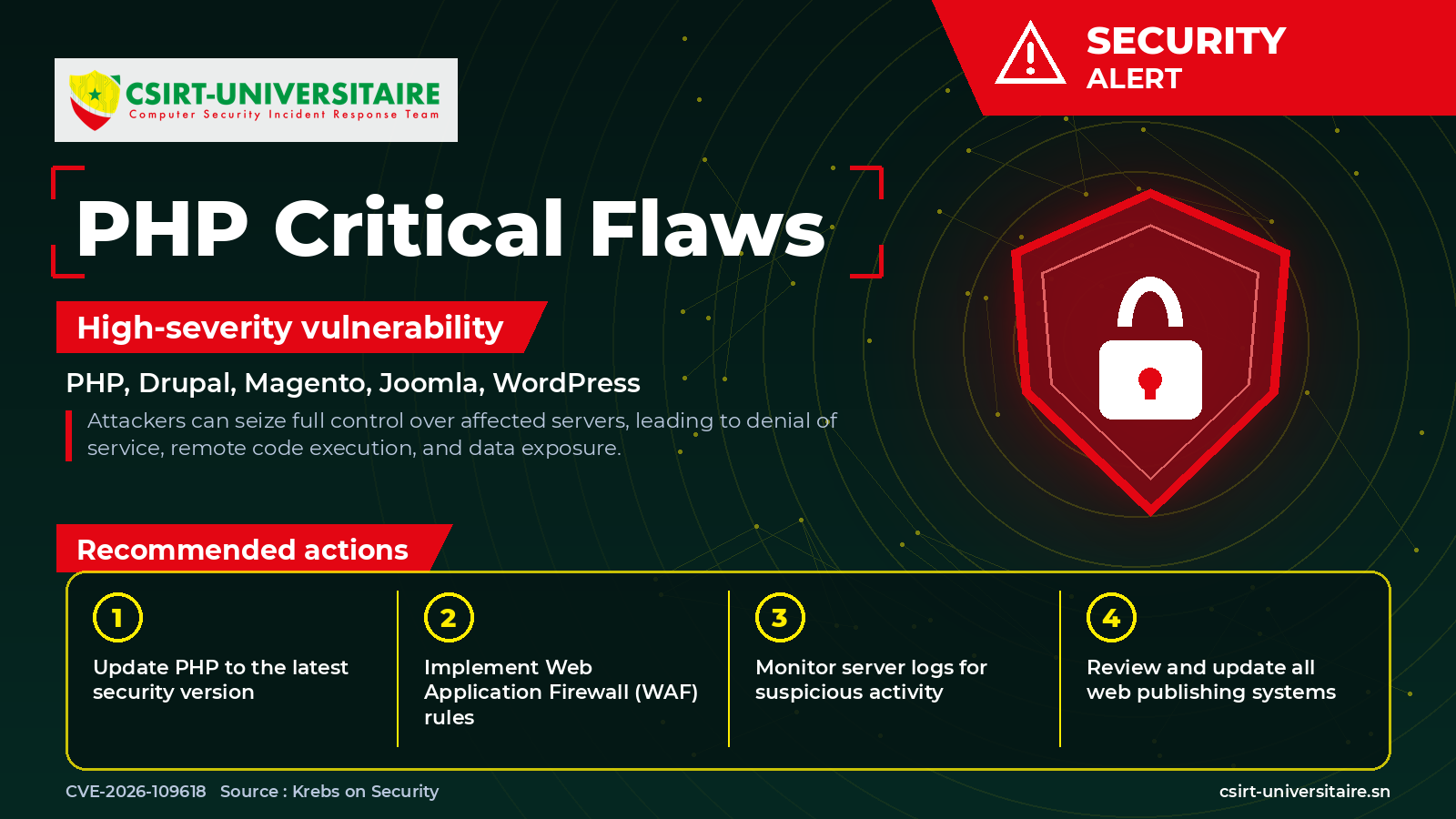
Deux vulnérabilités critiques affectant PHP, CVE-2026-109618 et CVE-2026-109619, permettent l'exécution de code à distance et la prise de contrôle de serveurs. Ces failles sont activement exploitées dans la nature et concernent une large majorité des sites web utilisant PHP, nécessitant une mise à jour urgente.
En détail
Les vulnérabilités résident dans la gestion des erreurs de mémoire (OOM) par PHP, où l'utilisation de longjmp() pour quitter le contexte actuel peut laisser la mémoire de la requête dans un état non initialisé. Les procédures de nettoyage ultérieures peuvent alors lire ou se brancher sur cette mémoire non initialisée, ce qui peut être déclenché de manière cohérente par diverses stratégies OOM et mener à une exécution de code à distance (RCE).
Ces failles affectent toutes les versions de PHP 5.4 et ultérieures, ce qui représente environ 70% des sites web. Des exploits fonctionnels sont confirmés et l'exploitation active est déjà détectée, notamment par Cloudflare qui a mis en place des règles WAF. La complexité de l'exploitation a été significativement réduite par l'utilisation de modèles d'IA, transformant une faiblesse ancienne en une menace immédiate et généralisée. L'impact est comparé à celui de Log4Shell en raison de la profondeur d'intégration de PHP dans l'écosystème web.
Produits et versions concernés
- Php php >= 7.3.0 < 8.2.35
- Php php >= 8.3.0 < 8.3.36
- Php php >= 8.4.0 < 8.4.27
- Php php >= 8.5.0 < 8.5.12
- Siemens ruggedcom ape1808 firmware
- Paloaltonetworks pan-os >= 10.2.0 < 10.2.7
- Paloaltonetworks pan-os 10.2.7
- Paloaltonetworks pan-os 10.2.8
Impact
Un attaquant peut obtenir le contrôle total des serveurs affectés, exécuter du code arbitraire, provoquer des dénis de service et exposer des données. L'installation de backdoors web (webshells) est une conséquence probable, permettant un contrôle distant persistant des sites compromis.
Exploitation
Exploitation active confirmée (catalogue CISA KEV). Des exploits fonctionnels sont disponibles et l'exploitation est détectée dans la nature.
Mesures recommandées
- Appliquer immédiatement les mises à jour de sécurité PHP vers les versions 8.5.12, 8.4.27, 8.3.36 ou 8.2.35.
- Mettre à jour les packages PHP via les gestionnaires de paquets de votre système d'exploitation (ex: Ubuntu a publié des mises à jour).
- Déployer ou renforcer les règles de pare-feu d'applications web (WAF) pour bloquer les tentatives d'exploitation connues.
- Surveiller les journaux des serveurs web pour détecter des activités suspectes ou des tentatives d'exploitation.
- Évaluer la possibilité de mettre à jour les applications web (Drupal, Magento, Joomla, WordPress) qui dépendent de PHP, car elles pourraient nécessiter des versions spécifiques de PHP.
Vérifier son exposition
- Vérifier les versions de PHP installées sur tous les serveurs web.
- Analyser les journaux d'accès et d'erreurs des serveurs web pour des requêtes inhabituelles ou des erreurs liées à la mémoire.
- Rechercher la présence de webshells ou de fichiers suspects sur les serveurs PHP.
- Utiliser des outils de détection d'intrusion (IDS/IPS) pour identifier les schémas d'attaque liés à ces vulnérabilités.
Synthèse rédigée automatiquement à partir de la source officielle. En cas de doute, la source fait foi.
Fiche technique · CVE-2026-109618
| Score CVSS | 9,2 (Critique) · CVSS 4.0 |
|---|---|
| Vecteur d'attaque | Réseau (à distance) |
| Complexité | Élevée |
| Privilèges requis | Aucun |
| Interaction utilisateur | Aucune |
| Faiblesse | CWE-1325, CWE-416, CWE-755, CWE-824 |
| Exploitation | Activement exploitée (catalogue CISA KEV) Apply mitigations in accordance with vendor instructions, ensuring compliance with CISA’s BOD 26-04 Prioritizing Security Updates Based on Risk (see URL in Notes) guidance and CISA’s “Forensics Triage Requirements” (see URL in Notes). Follow applicable BOD 26-04 guidance for cloud services or discontinue use of the product if mitigations are unavailable. Stakeholders are responsible for evaluating each asset's internet exposure and ensuring adherence to BOD 26-04 patching guidelines. |
| Publiée le | 2026-10-21 · mise à jour le 2026-11-20 |
Texte d'origine de la source (en anglais)
Expect to see quite a few websites serving error pages today: Nearly 70 percent of websites need to update their core software to fix a pair of vulnerabilities that allow an attacker to seize full control over affected servers. Experts say there are working exploits for the flaws, and that these critical bugs are already being exploited in the wild. Image: Shutterstock.com, Sashkin. The flaws at issue are present in PHP , the programming language that powers sites running on a large number of web publishing systems, including Drupal , Magento , Joomla and WordPress . Earlier today, PHP released an emergency security update to fix two critical bugs that can allow an attacker to execute code of their choosing on a vulnerable server. Reuters reports that government websites in Europe and elsewhere went offline today after the PHP vulnerabilities were disclosed. Cloudflare said it has already detected some exploitation of the flaw, and that at 3:02 am (UTC) it implemented web application firewall rules to protect websites from attack traffic seeking to exploit the bugs, which could cause a denial of service condition, remote code execution, and data exposure. OpenAI , which was involved in the vulnerability research and outreach, said “given the severity of these flaws and PHP’s widespread use, we consider this one of the most impactful security issues in recent memory.” Censys , a company that tracks the technology used by Internet hosts, said a recent scan identified approximately 2.58 million Internet facing hosts and 54.9 million web properties running PHP. Security experts at Wiz said every PHP version released in the last decade is affected by at least one of these vulnerabilities [full disclosure: Wiz is an advertiser on this blog]. “These findings rank among the most severe vulnerabilities discovered in PHP, and arguably in software history,” reads a blog post published today by a team of researchers at Wiz, which was one of several organizations credited with discovering the vulnerabilities. “The underlying flaws had been present for decades, but demonstrating their exploitability required an exceptionally complex chain of steps, at the edge of what human researchers could practically achieve. Frontier AI models substantially reduced that barrier, turning a longstanding flaw into an exploit.” The Wiz researchers say it is likely the PHP vulnerabilities will be mass-exploited to install web-based backdoors or “web shells,” which give attackers a web-based panel that allows them to remotely control infected sites. Wiz said that prior to the PHP bugs being publicly disclosed, the company worked with the PHP team, Calif and OpenAI to measure the size of the problem and coordinate patch verification and disclosure. The PHP zero-day vulnerabilities are being tracked by their CVE numbers, CVE-2026-109618 and CVE-2026-109619 , and they affect all web servers running PHP 5.4 or later. The bugs are fixed in PHP 8.5.12 , 8.4.27 , 8.3.36 , and 8.2.35 . According to Wiz, PHP is so deeply embedded in many web applications that we are likely to see organizations struggling to patch these vulnerabilities for some time to come, comparing this PHP vulnerability pair with the Log4Shell weakness that emerged in 2021 - a widespread, severe-as-it-gets security flaw in Log4j, a popular Java logging framework. “A vulnerability in core PHP reaches far beyond a single application,” the Wiz researchers wrote. “PHP runs across clouds, hosting providers, content-delivery networks and millions of independently managed servers. Reducing exposure before the technical details became public required coordinated work across that entire ecosystem.” The SANS Internet Storm Center is keeping an eye on major software platforms that are shipping updates to deal with these PHP flaws. For example, Ubuntu just released updated PHP packages. For a technical deep-dive on these vulnerabilities that tells the timeline of the discovery of these bugs in a comic book style, check out this post from Calif , another technology company credited with finding the PHP flaws. A snapshot of php2shell.censys.com, the website Censys set up to track the PHP vulnerabilities. This is a fast-moving story. Updates will be noted here with timestamps. Update, 2:30 pm ET: Add figures from Censys and a link to Calif’s writeup.
Source
Krebs on Security · publié le 21 octobre 2026
Lire la source originaleRéférences complémentaires
- https://github.com/php/php-src/security/advisories/GHSA-w8hw-w9fx-j79w Mitigation, Vendor Advisory
- http://seclists.org/fulldisclosure/2026/Oct/51 Mailing List
- http://www.openwall.com/lists/oss-security/2026/10/21/6 Mailing List, Third Party Advisory
- http://www.openwall.com/lists/oss-security/2026/10/23/5 Mailing List, Third Party Advisory
- https://github.com/rapid7/metasploit-framework/pull/22139 Third Party Advisory
- https://arcticwolf.com/resources/blog/php2shell-critical-php-vulnerabilities-enable-unaut… Third Party Advisory
- https://cert-portal.siemens.com/productcert/html/ssa-166980.html Third Party Advisory
- https://cert-portal.siemens.com/productcert/html/ssa-566435.html Third Party Advisory
- https://cert-portal.siemens.com/productcert/html/ssa-566512.html Third Party Advisory
- https://php2shell.delftintellab.com Third Party Advisory
- https://www.cisa.gov/known-exploited-vulnerabilities-catalog?field_cve=CVE-2026-109618 US Government Resource
- https://www.wiz.io/blog/php2shell-php-rce Third Party Advisory